Deposit Plan
5 The Development Strategy Comment
5.1The Deposit Plan sets out the Development Strategy (the Strategy) to facilitate sustainable growth in the County Borough up to 2035. It has been informed by a comprehensive and robust evidence base and responds to a range of key challenges identified throughout the plan preparation process. It considers how the County Borough will grow, and broadly where this growth will be distributed to deliver the Vision and Objectives set out earlier.
5.2The Strategy has been developed with full regard to:
- The national, regional and local policy context.
- Stakeholder engagement and involvement on the Vision, Issues and Objectives, Spatial Strategy Options and Growth Options.
- The key social, economic, environmental, and cultural issues relevant to Caerphilly County Borough.
- A range of population, household, dwelling and employment growth scenarios.
- Sustainable Settlements Analysis.
- Local Housing Market Assessment (LHMA).
The Level of Growth Comment
5.3Caerphilly County Borough is located within the Cardiff Capital Region which, through its City Deal, has ambitious economic and job growth aspirations. In addition, it is also located within the National Growth Area identified in Future Wales, which seeks a commensurate level of growth to be provided in this area. A fundamental part of any strategy that seeks to satisfy these requirements is a population that supports appropriate level of growth.
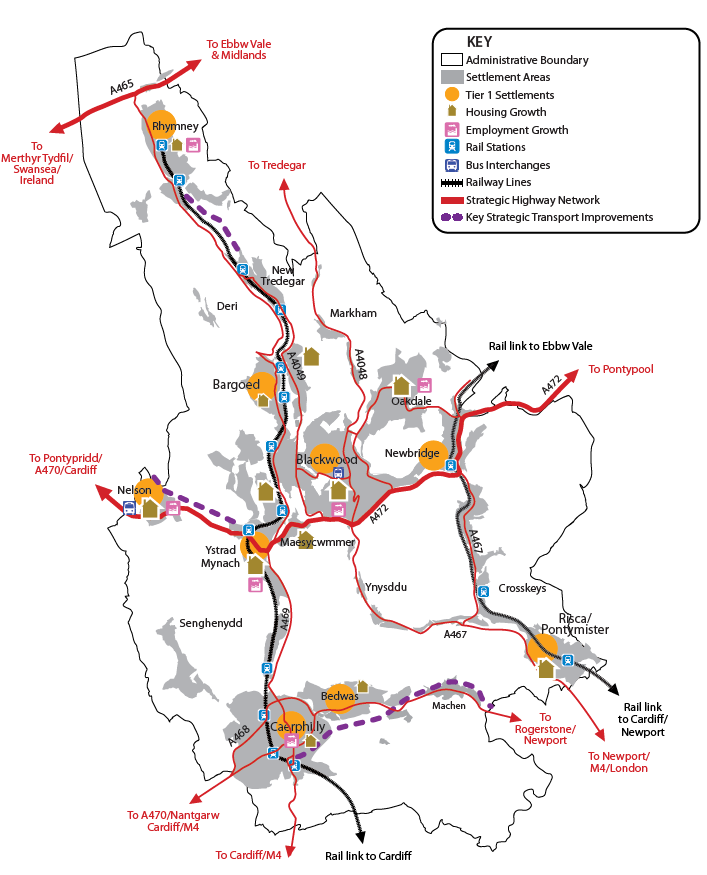
- The 2RLDP makes provision for 6,165 homes over the plan period, plus a flexibility allowance, including 1,906 affordable homes. This growth scenario supports a projected increase in both overall population and, crucially, the working-age population, which is essential for sustaining economic growth, attracting investment, and meeting regional employment targets.
- The 2RLDP allocates 40.3 Ha of employment land across a range of sites. It sets the policy framework to support job growth as well as policies designed to facilitate sustainable growth across key foundational sectors, including retail, leisure and tourism.
5.4Further detail is set out in evidence base paper EB5: Housing and Employment Growth Options.
The Spatial Distribution of Growth Comment
5.5To enable active and healthy lives, people should be able to easily walk to local facilities and public transport. ‘Walkable neighbourhoods’ are a cornerstone of national land-use planning policy, designed to create healthy, sustainable communities and enforce the Welsh Government’s sustainable transport hierarchy. Under PPW and Active Travel Act Guidance walkable neighbourhoods are characterised by having a comprehensive range of daily facilities located within a comfortable 20-minute walking distance of residential areas.
5.6The Strategy seeks to locate development in the most sustainable locations. To inform the spatial distribution of growth, the 2RLDP sets out two key elements for the location of development. Both elements have been derived from policies contained in Future Wales.
A Town Centre First Focus Comment
5.7This element of the strategy reflects Future Wales Policy 6 - Town Centre First, which prioritises the health and vibrancy of town centres and promotes them as the focus for commercial activity, as well as complementary and community-oriented land uses. Future Wales Policy 6 - Town Centre First requires significant new commercial, retail, education, health, leisure and public service facilities to be located within town centres.
5.8Locating new residential development within the Tier 1 Settlements, comprising Principal Town Centres and Local Centres, allows future residents to walk, cycle and use public transport to easily access the many services and facilities within them.
5.9Whilst the 2RLDP will seek to locate development within the Tier 1 and Tier 2 Settlements, to accommodate growth, the 2RLDP will also need to consider other settlements that are sustainably located.
A Metro Investment Focus Comment
5.10Derived from Future Wales Policies 12 and 36, this element seeks to maximise the benefits arising from the significant investment in the South East Wales Metro. While reducing the need to travel is a key policy objective of the 2RLDP, it is recognised that people will need to travel for work, services and leisure. Clustering housing, jobs and services within easy walking and cycling distance of rail stations, bus stations and interchanges, promotes walkable neighbourhoods and facilitates journeys being made by other means than the private car.
5.11Focusing new development in and around Tier 1 and Tier 2 Settlements, and around rail stations, bus stations and interchanges will contribute to overall aim of reducing the need to travel and increasing modal shift to walking, cycling and public transport, which are underlying aims of Future Wales.
Key Diagram Comment
5.12The Key Diagram shows the extent of Caerphilly County Borough and the 2RLDP area, and the interrelationships with adjoining local authorities. It identifies the Tier 1 Settlements containing Principal Town Centres and Local Centres, as well as rail stations and bus interchanges, and illustrates the areas for growth.