
Deposit Plan
3 The Caerphilly County Borough Context Comment
The County Borough Comment
3.1Caerphilly County Borough is centrally located within South East Wales, and forms part of the Cardiff Capital Region. It borders a number of local authority areas: Cardiff, Newport, Rhondda Cynon Taf, Merthyr Tydfil, Torfaen and Blaenau Gwent within its own region; and Powys and the Bannau Brycheiniog National Park directly to the north.
3.2Roughly 28,000 ha. in area, the County Borough is characterised by the three, main river valleys that constitute its geography, namely the Rhymney, Sirhowy and Ebbw. Almost 80% of the County Borough is countryside, offering vast areas of open landscape, mountain, woodland and expansive country parks and excellent cycling and walking routes.
3.3Several towns provide facilities and services at the local level as well as smaller villages and residential settlements. The County Borough has strong links, particularly in economic terms, to the cities of Cardiff and Newport, which complement the local, manufacturing-led economic base.
Settlement Structure Comment
3.4The County Borough broadly comprises five areas: The Heads of the Valleys to the north, the wider Ystrad Mynach and Blackwood areas forming the mid-valleys corridor, and Caerphilly and the Lower Ebbw and Sirhowy Valleys to the south.
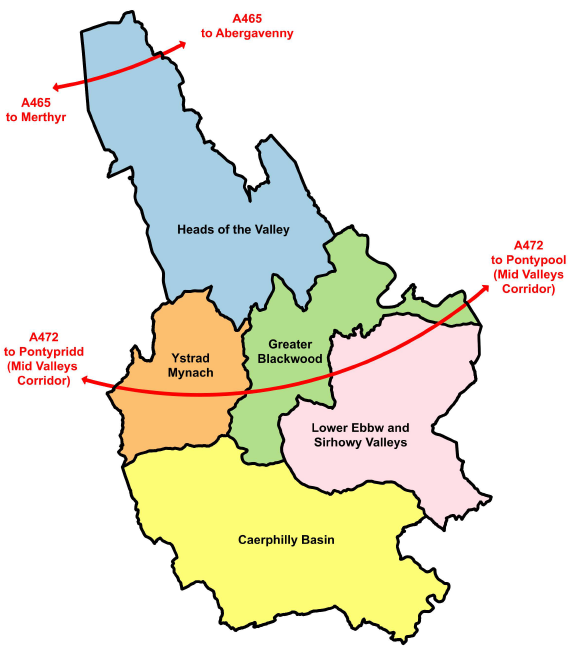
3.5Within these areas, a settlement hierarchy defines five different tiers of settlement. For the purposes of the 2RLDP, some settlements have been clustered where a sustainable functional linkage can be demonstrated.
3.6Within the Tier 1 Settlements, Principal Town Centres and Local Centres have been identified. These are the retail and commercial centres that contain the highest level of shops, services and facilities. The settlement structure is further detailed within Policy SP2: Settlement Hierarchy, Policy SP11: Retail and Commercial Centre Hierarchy and evidence base paper EB2: Sustainable Settlements Analysis.
Heads of the Valleys Comment
3.7The settlements within the Heads of the Valleys area are:
|
Tier 1 Settlements: |
Bargoed and Gilfach, comprising Bargoed Principal Town Centre Rhymney, comprising Rhymney Local Centre |
|---|---|
|
Tier 2 Settlements: |
Pontlottyn; New Tredegar; Aberbargoed. |
|
Tier 3 Settlements: |
Abertysswg; Markham. |
|
Tier 4 Settlements: |
Llechryd; Princetown; Fochriw; Deri; Hollybush; Argoed. |
3.8Bargoed and Gilfach form the largest settlement for the north of the County Borough and it has a role as its main retail, commercial and service location. In recent years, there have been positive developments with the completion of Angel Way which has improved accessibility, the development of Morrison’s and Lowry Plaza and the relocation of Bargoed Library into the former Hanbury Chapel. However, challenges remain in the form of high commercial vacancy rates, particularly at the northern end of the town centre close to the main transport hub which comprises the bus and rail stations.
3.9The presence of this transport hub, coupled with the planned network improvements as part of the Metro proposals, provides an excellent opportunity for Bargoed to diversify its current role and increase the presence of other uses such as offices and residential in addition to consolidating its retail offer.
3.10Located at the north of the county borough, Rhymney contains a moderate level of services and facilities and a number of employment opportunities as well as a rail station. It is well-located to the A465 Heads of the Valleys Road, with excellent connectivity to neighbouring authorities, as well as West Wales and the Midlands.
Ystrad Mynach Comment
3.11The settlements within the Ystrad Mynach area are:
|
Tier 1 Settlements: |
Ystrad Mynach (including Penallta and Tredomen), comprising Ystrad Mynach Principal Town Centre Nelson, comprising Nelson Local Centre |
|---|---|
|
Tier 2 Settlements: |
Cefn Hengoed and Hengoed |
|
Tier 3 Settlements: |
Glan-y-nant and Tir-y-berth; Penpedairheol and Glyngaer; Gelligaer and Penybryn. |
|
Tier 4 Settlements: |
None. |
3.12Ystrad Mynach, including Penallta and Tredomen, is the largest settlement within the western part of the Mid Valleys Corridor and serves as the County Borough’s administrative centre, accommodating the Council headquarters, Ysbyty Ystrad Fawr and a local campus of Coleg y Cymoedd. Investment in recent years has seen the development of the Centre for Sporting Excellence, and its town centre is performing well in terms of the number and range of commercial units in operation, the low number of commercial vacancies, and the healthy level of footfall in comparison to other centres.
3.13In terms of employment, the Tredomen Park campus provides office space and is well-located in relation to the A472 east-west road link (and in turn, the A470) and the Ystrad Mynach railway station. The 2RLDP will seek to encourage proposals that optimise the social and economic benefits of these facilities, where appropriate.
3.14Nelson contains a moderate level of services and facilities and a number of employment opportunities as well as a bus station. It is well-located to the A470 with easy access to the M4.
Greater Blackwood Comment
3.15The settlements within the Greater Blackwood area are:
|
Tier 1 Settlements: |
Blackwood (including Cefn Fforest and Pontllanfraith), comprising Blackwood Principal Town Centre |
|---|---|
|
Tier 2 Settlements: |
Maesycwmmer; Oakdale and Croespenmaen. |
|
Tier 3 Settlements: |
Pengam and Fleur-de-lis. |
|
Tier 4 Settlements: |
None. |
3.16Blackwood, including the communities of Cefn Fforest and Pontllanfraith, is the largest settlement in the eastern part of the Mid Valleys Corridor. Whilst Blackwood does not have a railway station, its bus station serves as the local transport hub and provides valuable local and sub-regional services to Cardiff and Newport.
3.17Its town centre is one of the County Borough’s two most-utilised, along with Caerphilly, as reflected by the scale and range of commercial provision, although there are pockets of vacant floorspace.
3.18The Sirhowy Enterprise Way has improved road-based transport in respect of the employment offer at the strategically important Oakdale Business Park. Whilst Oakdale and Croespenmaen are distinct communities, they are treated as a coherent settlement for the purposes of the 2RLDP. It is envisaged that the South Wales Metro will provide additional opportunities for public transport integration and the ability to increase connectivity to the area both locally and sub-regionally.
Lower Ebbw and Sirhowy Valleys Comment
3.19The settlements within the Lower Ebbw and Sirhowy Valleys are:
|
Tier 1 Settlements: |
Risca and Pontymister, comprising Risca Principal Town Centre Newbridge, comprising Newbridge Local Centre |
|---|---|
|
Tier 2 Settlements: |
Crosskeys and Pontywaun. |
|
Tier 3 Settlements: |
Crumlin; Abercarn and Cwmcarn; Pantside; Cwmfelinfach; Wattsville. |
|
Tier 4 Settlements: |
Trinant; Hafodyrynys; Wyllie; Ynysddu; Brynawel. |
3.20Whilst Risca and Pontymister are distinct communities, for the purposes of the 2RLDP, they are treated as one coherent Tier 1 Settlement within the Lower Ebbw and Sirhowy Valleys area, and its range of commercial and community-oriented facilities is reflective of this. It benefits from good transport connectivity with Newport and Cardiff in terms of rail, as well as by road via the A467 and the nearby M4.
3.21Historically, flood risk concerning land in close proximity to the River Ebbw has been a major impediment to development. Whilst this remains the case, the 2RLDP will seek to make provision for, and encourage, proposals that support Risca-Pontymister’s role and function, where appropriate.
3.22Newbridge contains a high level of services and facilities and a number of employment opportunities as well as a rail station.
Caerphilly Basin Comment
3.23The settlements within the Caerphilly Basin area are:
|
Tier 1 Settlements: |
Caerphilly, comprising Caerphilly Principal Town Centre Bedwas and Trethomas, comprising Bedwas Local Centre |
|---|---|
|
Tier 2 Settlements: |
Llanbradach. |
|
Tier 3 Settlements: |
Abertridwr; Graig-y-rhacca; Machen. |
|
Tier 4 Settlements: |
Senghenydd; Porset; Rudry; Waterloo. |
3.24Caerphilly is the County Borough’s largest settlement and serves as the largest Tier 1 settlement for the south of the County Borough, particularly the Caerphilly Basin area. Investment is ongoing through the Caerffili 2035 regeneration programme, which will deliver a number of interrelated schemes including the redevelopment of the town’s transport interchange, residential and commercial development within the town centre – such as the Ffos Caerffili market, which is already operational, the redevelopment of Pentrebane Street for a mixed use development, together with schemes designed to optimise tourist-related benefits due to the presence of Caerphilly Castle.
3.25Caerphilly is defined as a sub-regional centre and forms an important element of the National Growth Area set out in Future Wales. Whilst there are matters of sensitivity, including the requirement to designate an area of green belt to the south east of the town, its status within the 2RLDP, and the policies and proposals set out therein, is reflective of its sub-regional role.
3.26The communities of Bedwas and Trethomas serve as a Tier 1 settlement within the area, containing a high level of services and facilities and a number of employment opportunities as well as high frequency bus services.
Population
3.27With almost 177,000 permanent residents (mid-2024 estimate), Caerphilly is the fifth most populous local authority in Wales. Since 2011, however, its population has experienced a slight decline in both absolute terms and in its working-age population, with just over 61% of people aged between 16 and 64 in 2024.
Economy
3.28Even though the working-age population has declined, a higher percentage of people were economically active in 2025 (76.9%) than in 2021 (75%) and 2011 (70.2%). The percentage of residents who are unemployed dropped between 2011 and 2025 (from 10.5% to 4.1%), but in the same period the percentage of residents who are retired went up (from 14.2% to 21.8%).
3.29While the proportion of County Borough residents with qualifications is below the national average, the number of people employed locally increased between 2011 and 2025. This reflects the continuing prevalence of the manufacturing sector within the County Borough but also some degree of resilience in the economic base. However, out-commuting remains a significant factor. Whilst the number of businesses appears not to have grown since 2011, their combined turnover has increased from £3,459m in 2011 and £4,768m in 2021 to £5,428m in 2025.
Housing
3.30Since the LDP was adopted in November 2010 there has been a continued shortfall in the rate of housing development. By 2025 only 76% of the LDP’s total housing requirement (6,549 of 8,625 units) and just over 40% of the affordable housing target had been met. In common with general trends, housing in the County Borough has become less affordable, with average house prices having risen to just over four years’ average earnings in 2025.
Transport
3.31Caerphilly County Borough’s transport network includes active-travel routes, several bus stations (Blackwood, Caerphilly, Bargoed and Nelson) and the Rhymney Valley and Ebbw Valley railway lines. The County Borough has good transport access via the A465 in the north and the M4 motorway and the A470 in the south and west respectively, with the A472 corridor connecting the Mid Valleys corridor across several local authority areas.
Natural environment
3.32Important features of the natural environment include a number of sites subject to statutory designations, including Sites of Special Scientific Interest (SSSIs), Local Nature Reserves (LNRs) and one Special Area of Conservation (SAC). There are a number of country parks, Special Landscape Areas (SLAs) and Visually Important Local Landscapes (VILLs) designated for their landscape value, and Sites of Importance for Nature Conservation (SINCs) designated for their nature value.
Historic Environment
3.33The historic environment consists of conservation areas, listed buildings, scheduled monuments, historic parks and gardens and many locally significant buildings.
Visitor economy
3.34The County Borough accommodates a range of visitor attractions within its main towns and elsewhere, including Caerphilly Castle, Blackwood Miners’ Institute, Cwmcarn Forest Drive and the country parks, each of which possesses its own, distinctive character and associated facilities. A programme of events including food and drink festivals and spring and Christmas fairs is undertaken within each of the five principal town centres on an annual basis, complementing the commercial and cultural offer of these locations and attracting businesses and visitors from within the County Borough and beyond.
3.35Additionally, there is opportunity to benefit from the County Borough’s location at the southern edge of the Bannau Brycheiniog National Park.
Challenges and opportunities Comment
3.36The County Borough faces some persistent social and economic challenges. Certain areas, especially those in the north, have residents with low levels of academic and vocational achievement and suffer from persistent, long-term ill health and economic inactivity. The rate of housing and employment-related development has stagnated over the lifetime of the Adopted LDP and, although by no means specific to Caerphilly County Borough, existing town centres are presented with challenging conditions due to changing retail and commercial trends and are faced with the need to diversify. All of this is set against the backdrop of a projected shift in demographic structures, with a likely reduction in the working age population relative to the proportion of people in older age groups, continued financial pressure on public services and the existential issue of climate change.
3.37However, there are many opportunities. The County Borough’s economic base has proven itself to be resilient over time, with the manufacturing sector in particular continuing to locate here. Whilst out-commuting levels remain high, this does demonstrate the interconnected nature of the wider region and demonstrate the County Borough’s capability to take advantage of regional growth and investment. The Cardiff Capital Region and the South Wales Metro have the potential to act as catalysts in terms of further enhancing sustainable transport links both locally and regionally, while the National Growth Area may assist in providing the public policy context for economically and socially beneficial development of a sustainable location and scale.
